How to Choose a Fiduciary Financial Advisor in Tampa Bay, FL
Why “fiduciary” matters in Tampa Bay
In the financial industry, “fiduciary” is not a marketing buzzword—it’s a specific legal and ethical standard that requires an advisor to put your interests ahead of their own at all times.
Under the Investment Advisers Act of 1940, SEC‑registered investment advisers owe clients a fiduciary duty that includes both a duty of loyalty and a duty of care.
By contrast, many brokers and insurance agents still operate under Regulation Best Interest or suitability standards, which focus on whether a recommendation is “appropriate” at the moment of sale—not whether it’s truly the best option for you over the long term.
Fiduciary vs suitability vs Reg BI
At a high level, three standards show up in Tampa Bay’s advisor landscape:
Standard | Who uses it | What it requires | What it allows |
|---|---|---|---|
Fiduciary (Advisers Act) | Registered Investment Advisers and their reps | Put client’s interests first across the entire relationship; avoid or fully disclose and manage conflicts; ongoing duty of care | Typically fee-based or fee-only structures; lower tolerance for conflicted compensation |
Regulation Best Interest (Reg BI) | Broker-dealers and registered reps | Act in “best interest” at the time of a securities recommendation; disclose and mitigate conflicts | Commissions and product-based incentives still allowed if disclosed |
Suitability (FINRA) | Brokers under older rules, some insurance/annuity reps | Ensure recommendations are “suitable” given age, goals, risk tolerance | Recommending a higher-cost or higher-commission product can still be acceptable if “suitable” |
The practical takeaway for a retiree in Clearwater or Tampa: a fiduciary advisor must work for you, not for the sale; a suitability or Reg BI advisor must consider your interests when selling you something, but may still be operating inside compensation structures that reward certain products over others.

Why Tampa Bay retirees particularly need fiduciary advice
Florida’s lack of state income tax is a plus, but retirees here still face significant risks: high healthcare and insurance costs, hurricane‑related property risks, and heavy reliance on Social Security and pre‑tax retirement accounts for income.
Research on retiree regrets shows common issues like claiming Social Security too early, failing to plan for required minimum distributions (RMDs), underestimating healthcare and Medicare surcharges, and investing too conservatively.
Those decisions are often shaped by advice—sometimes from bank employees or product salespeople whose incentives are not fully aligned with the client’s long‑term best interest.
A fiduciary advisor, by contrast, is obligated to consider how every recommendation impacts your lifetime tax bill, survivor benefits, healthcare exposure, and portfolio durability, not just whether a single product is “okay” to sell you today.
Common retirement planning mistakes in Tampa Bay
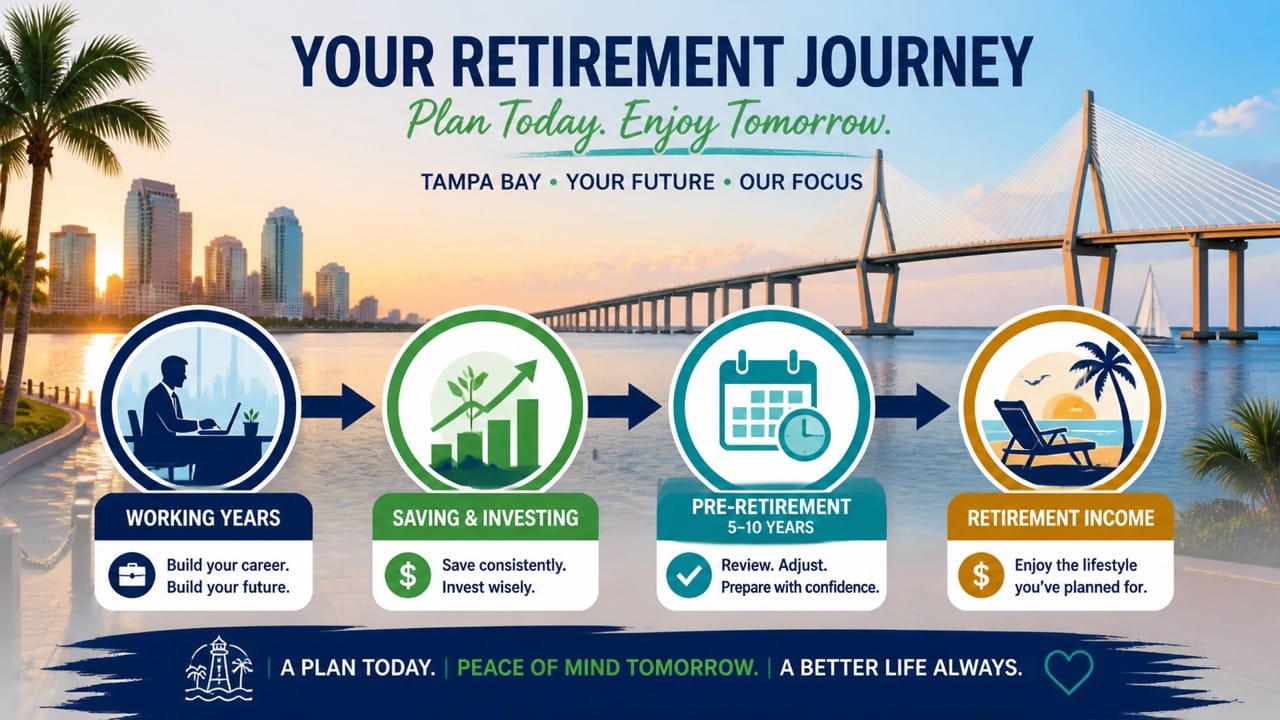
Local planners and national research highlight a few recurring mistakes that hit Tampa Bay retirees hard:
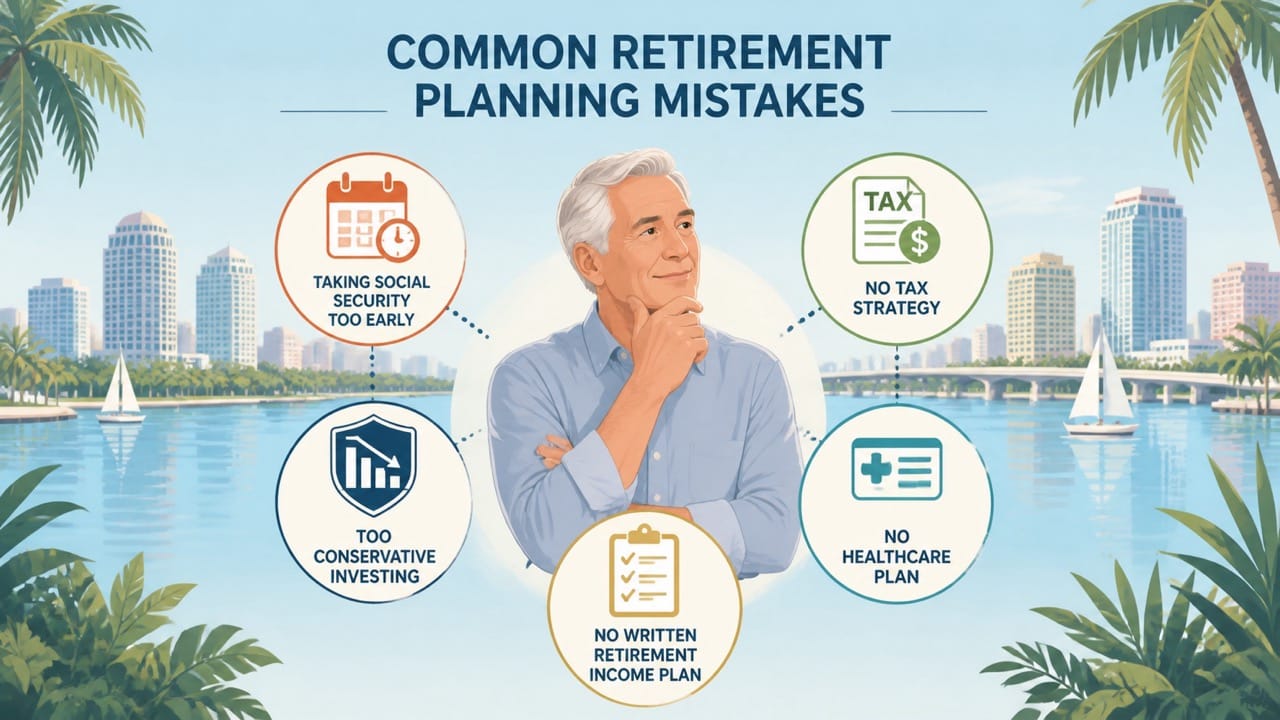
- Claiming Social Security at 62 without a plan. Taking benefits early can permanently reduce payments, even though delaying provides guaranteed increases each year up to age 70.
- Ignoring tax diversification. Loading everything into pre‑tax accounts can create big RMDs that push you into higher brackets, increase Medicare premiums, and cause more Social Security to be taxed.
- Investing too conservatively. Fear of market volatility leads some retirees to abandon equities entirely, increasing longevity risk—especially in a region where housing, insurance, and healthcare costs can rise faster than inflation.
- No written retirement income plan. Many couples pull money “where it feels right” without coordinating tax, investment, and healthcare decisions, which can quietly erode savings over time.
- Relying on one product pitch instead of a comprehensive plan. A single high‑commission annuity or proprietary fund sold at a bank branch is not a retirement strategy.
A good fiduciary advisor in Tampa or Clearwater should proactively address each of these areas—Social Security timing, tax diversification, investment allocation, income sequencing, and contingency planning—in an integrated way.
Step-by-step: how to vet a fiduciary financial advisor in Tampa Bay
1. Ask the non‑deflectable question
Start with a question that an honest fiduciary should answer clearly:
“Are you legally required to act as a fiduciary in my best interest 100% of the time, for every account and every recommendation—and will you put that in writing?”
If the answer is anything short of “yes” plus a written commitment, you are likely dealing with a hybrid or non‑fiduciary model.
2. Verify registration and disclosures (SEC & FINRA)
You can confirm what kind of advisor you’re dealing with in about ten minutes:
- SEC Investment Adviser Public Disclosure (IAPD). Search the firm and advisor at adviserinfo.sec.gov to see if they’re registered as an investment adviser and to read Form ADV Part 2 (the brochure explaining fees, services, and conflicts).
- FINRA BrokerCheck. Search the advisor at brokercheck.finra.org to see if they’re registered as a broker, and to review any customer complaints or regulatory actions.
- Form CRS. Many firms must provide a Customer Relationship Summary (Form CRS) that explains whether they act as an investment adviser, broker, or both, and how they are paid.
These documents reveal whether the advisor is an RIA (fiduciary), a broker (Reg BI/suitability), or both (hybrid)—and what conflicts might exist.
3. Understand how the advisor gets paid
Compensation is where conflicts live.
- Fee-only: All compensation comes directly from clients (percentage of assets under management, flat fee, or hourly). No commissions, no product payouts. This structure aligns strongly with fiduciary duty.
- Fee-based: Combination of client fees and commissions on certain products. May still involve incentives to recommend specific investments or insurance.
- Commission-driven: Income primarily from selling products. Suitable or Reg BI standards often apply; fiduciary duty may not.
Ask explicitly:
“Do you or your firm receive any commissions, revenue sharing, or other third‑party compensation from the products you recommend to me?”
A Tampa Bay fiduciary advisor should be able to explain their pay model in plain dollars for your situation—and why it minimizes conflicts.
4. Look for real credentials and experience
Certain designations and structures signal a higher bar:
- CFP® (Certified Financial Planner): CFP professionals must meet education, exam, and experience requirements and are required to act as fiduciaries when providing financial planning advice under CFP Board’s Code of Ethics.
- CFA® (Chartered Financial Analyst): Deep investment analysis and portfolio management expertise; useful for complex portfolios.
- NAPFA membership: Advisors in the National Association of Personal Financial Advisors are fee-only and sign a fiduciary oath.
Credentials don’t guarantee good advice, but they show the advisor has committed to standards beyond a weekend sales course.
5. Evaluate their planning depth, not just investment talk
For Tampa Bay retirees and pre‑retirees, you want a plan‑first fiduciary, not just an asset gatherer.
Ask how they handle:
- Retirement income strategy across IRAs, Roth accounts, taxable portfolios, and Social Security.
- Tax diversification and RMD management.
- Healthcare and long‑term care planning, including Medicare and insurance costs.
- Estate and multi‑generational wealth planning with local attorneys and CPAs.
A strong fiduciary firm will integrate tax, investment, retirement, and estate strategies into one written plan, not just a handful of pie charts.
6. Ask the right questions in a Tampa Bay context
Consider bringing these questions to your first meeting:
- Are you a fiduciary at all times, and will you sign a fiduciary oath?
- How are you compensated, in dollars, on a portfolio and plan like mine?
- What types of Tampa Bay and Clearwater clients do you typically work with (retirees, business owners, corporate professionals)?
- How will you help me coordinate Social Security timing, 401(k)/IRA rollovers, Roth conversions, and Florida-specific tax and insurance issues?
- How often will we meet, and how do you monitor and adjust my plan as markets and my life change?
You should walk away feeling that the advisor understands both the technical side of planning and the realities of living and retiring in Tampa Bay.

7. Red flags to avoid
Several patterns show up repeatedly in problematic advisor relationships:
- Product-first conversations. If the first meeting is dominated by annuity or proprietary fund brochures, not your goals and numbers, that’s a warning sign.
- Vague or evasive fee answers. “It depends” without clear math in dollars is not sufficient.
- No willingness to share Form ADV or Form CRS. These are required disclosures; reluctance to share them is a major red flag.
- Personal custody of assets. Your money should sit at an independent custodian like Schwab or Fidelity, not in the advisor’s own corporate account.
- Pressure to act quickly. Retirement decisions are long-term; you shouldn’t be rushed into locking up your savings.
How Trinity Wealth Management Group serves Tampa & Clearwater as a fiduciary partner
Trinity Wealth Management Group is a veteran‑owned, independent financial planning firm based in the Tampa Bay area, with a focus on retirement planning, investment management, tax diversification strategies, and multi‑generational wealth planning.
The firm states that it subscribes to the promise of acting in a fiduciary capacity—putting clients’ needs above all else—while offering one‑on‑one relationships, access to professional asset managers, and technology to keep your full financial picture visible.
For retirees and pre‑retirees in Tampa and Clearwater, Trinity’s work typically centers on:
- Retirement income planning: Coordinating Social Security, pensions, IRAs, Roth accounts, and taxable portfolios into a sustainable income strategy tailored to Florida’s cost of living.
- Investment management: Building and managing diversified portfolios aligned with your risk tolerance, time horizon, and need for inflation‑resistant growth.
- 401(k) rollovers and employer retirement plans: Helping you evaluate when and how to move money from workplace plans into IRAs, with careful attention to fees, investment options, and fiduciary oversight.
- Tax diversification strategies: Structuring savings across pre‑tax, Roth, and taxable accounts to manage lifetime tax exposure and RMDs.
- Insurance and risk management: Integrating life and long‑term care insurance solutions with your overall plan while acknowledging that Trinity does not provide legal or tax advice.
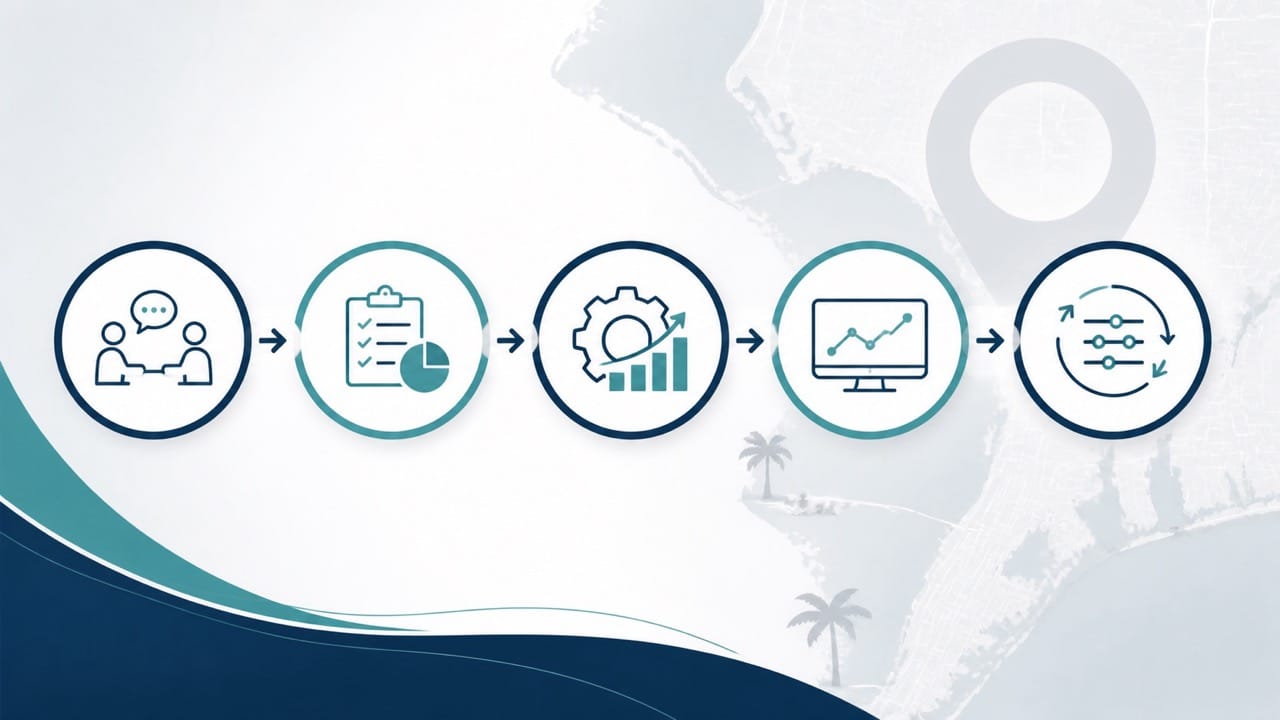
The firm’s “E.A.S.I.” process—Educate, Assess, Strategize, Implement—maps closely to the kind of fiduciary planning framework regulators and professional bodies encourage, even as federal rules around “fiduciary” status for one‑time retirement recommendations have recently been vacated.
For Tampa Bay residents who want fiduciary‑style retirement planning without being sold a single product solution, Trinity can function as the “first call” fiduciary partner—helping you understand your options, design a plan, and implement it with ongoing monitoring.
FAQ: Tampa Bay fiduciary advisors
Are all financial advisors in Tampa Bay fiduciaries?
No. Many advisors in banks, broker-dealers, and insurance agencies operate under Reg BI or suitability standards, not a full fiduciary duty, which means they may still be compensated by commissions and product incentives.
How do I verify that an advisor is a fiduciary?
Use SEC IAPD (adviserinfo.sec.gov) to confirm RIA status and read Form ADV; use FINRA BrokerCheck to review broker registrations and any disclosures; ask directly whether they are a fiduciary at all times and get that commitment in writing.
Does Regulation Best Interest protect me the same way a fiduciary duty does?
No. Reg BI requires brokers to act in your best interest at the time of a securities recommendation and to disclose and mitigate conflicts, but it does not impose the same ongoing duty of loyalty and care across the entire relationship, nor does it eliminate commission-based incentives.
Why is the Department of Labor “fiduciary rule” in the news?
The DOL’s 2024 Retirement Security Rule, which would have expanded fiduciary status for certain retirement advice, was vacated by federal courts and formally withdrawn in March 2026, restoring the older 1975 five-part fiduciary test under ERISA.
Practically, that means you cannot assume anyone giving you rollover or retirement product advice is a fiduciary—you have to choose one intentionally.
Do fiduciary advisors guarantee better investment returns?
No. Fiduciary duty governs whose interests come first, not performance; however, research from firms like Vanguard suggests that high-quality, fiduciary-style advice can improve net outcomes by helping clients with asset allocation, cost control, tax efficiency, and behavioral coaching.
Any advisor should avoid promising specific returns.
What is a fiduciary financial advisor in Tampa Bay, FL?
A fiduciary financial advisor in Tampa Bay is a financial professional—typically operating as a Registered Investment Adviser—who is legally and ethically obligated to put your interests ahead of their own, disclose and manage conflicts, and provide ongoing advice that serves your long‑term goals rather than product sales.
How can I confirm that my Tampa Bay advisor is a fiduciary?
Ask whether they are a fiduciary at all times and request that commitment in writing, then verify their registration and disclosures using the SEC’s Investment Adviser Public Disclosure site (Form ADV) and FINRA BrokerCheck to see how they are regulated and compensated.
What is the difference between a fiduciary advisor and a suitability-based advisor?
A fiduciary advisor must put your best interests first across the entire relationship and avoid or fully disclose conflicts of interest, while a suitability-based advisor need only recommend investments that are “appropriate” given your profile, even if higher-cost or higher-commission alternatives exist.
Why should Tampa Bay retirees prioritize fiduciary advisors?
Retirees here face complex decisions about Social Security timing, RMDs, tax diversification, healthcare costs, and longevity risk; a fiduciary advisor is required to consider how each recommendation affects your lifetime financial security rather than focusing on one product sale.
How does Trinity Wealth Management Group approach fiduciary retirement planning in Tampa and Clearwater?
Trinity Wealth Management Group is a veteran‑owned, independent firm that states it acts in a fiduciary capacity, focusing on retirement income planning, investment management, 401(k) rollovers, tax diversification, and multi‑generational wealth strategies for clients in the Tampa Bay area.